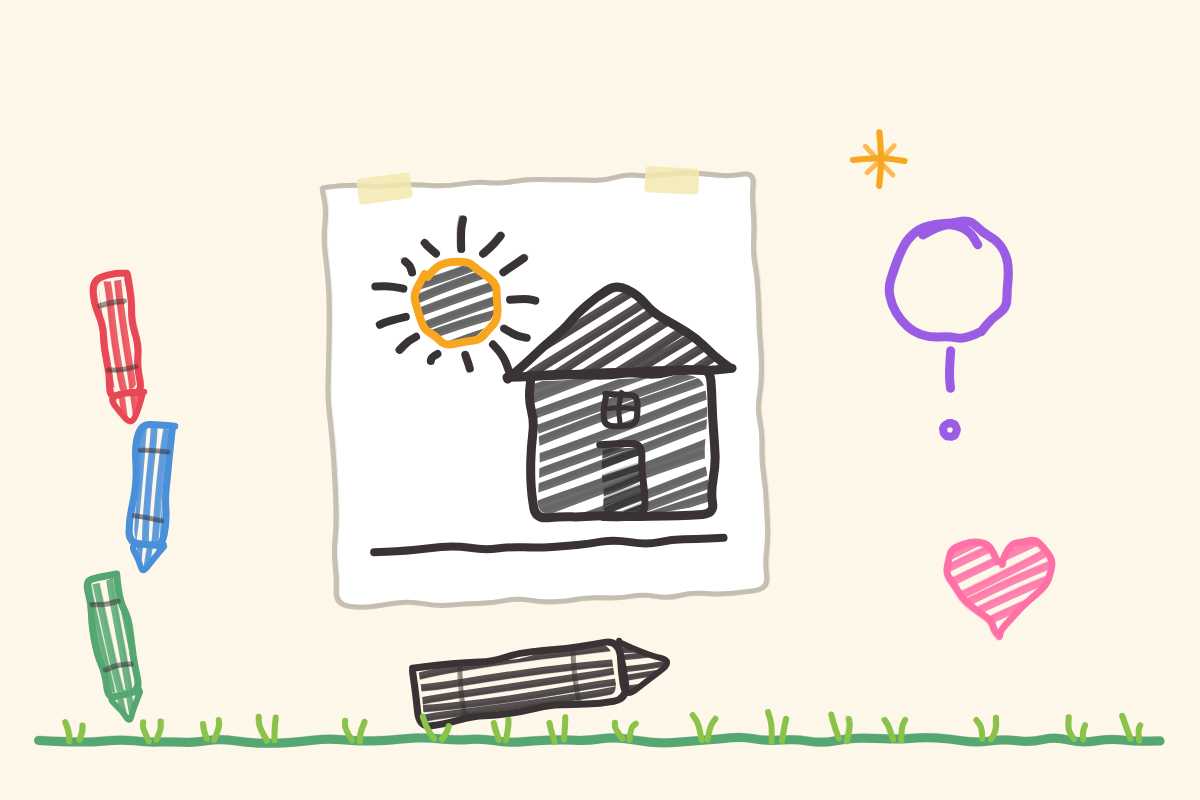
Somewhere in your house there's a stack of drawings, and every single one is black. Black suns. Black families. Black flowers, which you didn't know was possible until your child made twelve of them.
The full crayon box sits right there. Untouched. And a small voice in your head whispers the question you finally typed into a search bar: is something wrong?
Almost certainly not. Here's what's actually going on — with the black crayon, and with the six other drawing habits that send parents googling at midnight.
Why does my child only draw in black?
The unglamorous truth: black is the best crayon in the box, and your child figured that out before you did.
Black gives the strongest contrast on white paper. It makes the boldest line with the least pressure. When a young child is working hard on shapes — getting the circle to close, the legs to attach — colour is a distraction, and black is simply the most legible tool for the job. Many children go through an intense black-and-only-black phase for exactly this reason, then wander back to colour once the shapes come easily.
The idea that black drawings signal sadness or trouble comes from adult colour symbolism, not from children. Research on children's colour use keeps finding the same thing: young kids pick colours for practical and idiosyncratic reasons — what's sharpest, what's closest, what a best friend used — far more often than emotional ones. We went deeper on this in the hidden stories in colour choices.
When to look closer: if the all-black drawings arrive together with real changes elsewhere — sleep, appetite, withdrawal, a change at home or school — mention it to someone who knows your child. The signal is the cluster. It's never the crayon alone.
Why does my child draw the same thing over and over?
Forty rainbows. An unbroken series of identical cats. The same house, window by window, every day for a month.
This is called a schema — a pattern a child repeats in order to master it — and it's one of the healthiest things you can see on paper. Repetition is how children practise everything: the same story at bedtime, the same puddle jumped, the same cat drawn until the cat is right. Each repetition looks identical to us. To them, version thirty-one finally got the tail correct.
Artists call this "working in a series." When your child does it, it's not a rut. It's studio practice.
Why does my child scribble over their finished drawing?
Few things are more alarming to watch: twenty careful minutes on a drawing, then — scribble — gone, buried under loops.
Usually one of three things, none of them dark. Sometimes the scribble is part of the story ("then it rained on everything!"). Sometimes it's the pure physical pleasure of big arm movements after fiddly small ones. And sometimes it's a perfectionist move — the drawing didn't match the picture in their head, so they closed the file.
Ask before you rescue the page. "Tell me what happened here" gets you the real answer, and the way you ask matters.
Why did they leave someone out of the family drawing?
You count the figures. Someone's missing. Sometimes it's the dog. Sometimes it's you.
Before your heart drops: family drawings are snapshots of this morning, not verdicts on your relationship. Children draw who's most present in the scene they're imagining — a drawing of "pancake Saturday" stars whoever makes the pancakes. They also simply run out of room, or steam, and the last person to be drawn is the first one cut. Ask who's in the picture and where everyone else is; the answer is usually logistical ("You're at work. That's why there's a car.").
Why are the people floating in the air?
No ground, no sky, everyone drifting in white space — completely standard until age five or six. A baseline (that strip of green grass along the bottom) is a developmental arrival, not a starting point. When it appears, your child has started organising the world, not just the objects in it. Our age-by-age drawing guide shows when these pieces typically land.
Why does my child draw monsters and scary things?
Because monsters are where children do their bravest thinking. Paper is the one place a five-year-old is bigger than the thing under the bed — they can give it teeth, then give it a silly hat, then scribble it out entirely. Drawing a scary thing is processing, and it's much healthier out on the page than circling inside. Enjoy the monsters. Ask for their names.
When should I actually pay attention?
Any single habit on this list, by itself, in a child who is otherwise eating, sleeping, playing, and being their usual self: noise. Skip the worry.
Pay attention when drawing changes alongside the child — a previously chatty artist who goes quiet everywhere, drawings that repeatedly return to a specific frightening event, or themes that would concern you in any context. Then the drawings aren't the problem; they're a doorway. Walk through it gently, starting with "tell me about this one" — and if your gut still itches, bring the drawings to your paediatrician or a school counsellor. That's exactly what they're for.
The habit worth keeping
Here's the twist in all seven answers: the drawing alone told you almost nothing. The explanation told you everything. The black flower had a reason. The missing person was at work. The monster had a name, and the name was Kevin.
Children explain their drawings freely for a handful of years, and then — quietly, with no announcement — they stop. The decoded drawing was never the treasure. The decoder was.
So while your resident artist still narrates: ask, listen, and keep the answers. One day you'll want to remember exactly why everything, for one strange and wonderful winter, was black.
A gentle note from us: we're parents and makers, not paediatricians. Every child is wonderfully their own, and they grow at their own pace. If something about your little one's development is weighing on your heart, please have a chat with your family doctor — that's exactly what they're there for, and asking is always the right call.
Ready to start keeping their stories?
My Mini Canvas is on iPhone and iPad now — free to start, no account needed.