You saw another child's drawing on the preschool wall. A person with fingers. A house with a chimney. And next to it, your child's — a tangle of loops that could be a dog, a storm, or breakfast.
So you're here, at some late hour, typing "what should a 4 year old be able to draw" into a search bar.
Take a breath. Here's the honest answer, age by age — and the one thing the milestone charts never tell you.
First, the thing the charts never tell you
Drawing development has one of the widest "normal" ranges of any childhood skill. Wider than walking. Wider than talking. A completely typical classroom of four-year-olds contains children still scribbling and children drawing families with eyelashes — sometimes at the same table, sharing the same crayons.
Milestones below are typical, not required. A child six months "behind" on drawing is usually just a child who prefers running, building, or shouting.
What should a 2-year-old be able to draw?
Scribbles. Glorious, physical, whole-arm scribbles.
Around two, most children can hold a chunky crayon in a fist and make marks on purpose. By two and a half, many can imitate a vertical line, and the scribbles start to become circular. That's it. That's the milestone.
What looks like chaos is actually your child discovering cause and effect: my arm moves, and the world changes. That's not a small thing. That's the beginning of everything.
What should a 3-year-old be able to draw?
Around three, two lovely things happen.
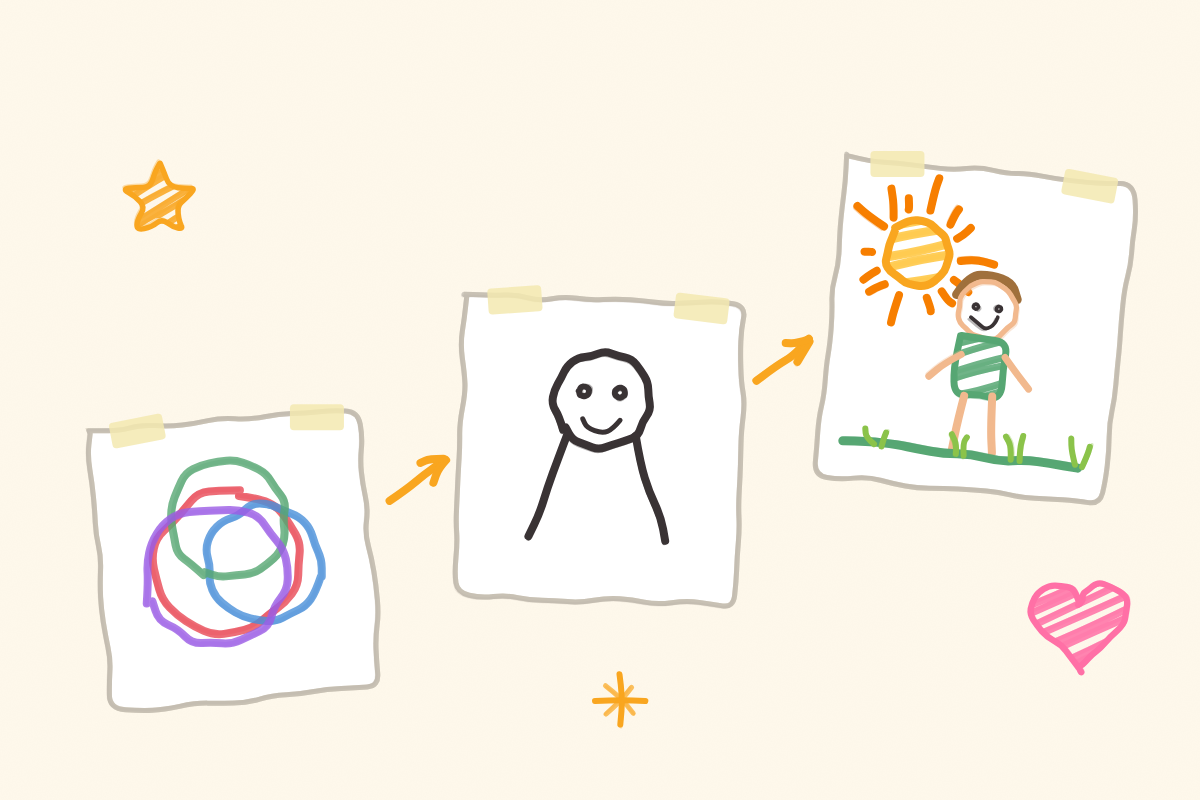
First, most children can copy a circle — a closed shape, which is harder than it sounds. Second, and far more magical: scribbles get names. Your child draws a tangle of lines, holds it up, and announces it's "Daddy at the shops."
The drawing didn't change. The intention did. Your child has discovered that marks can mean something — the same discovery that leads to writing.
This is also the age of the famous tadpole person: a circle with legs sprouting straight from the head, maybe arms out the sides, maybe not. No body. Tadpole people are not a mistake to correct — they're a developmental stage nearly every child on earth passes through, and one of the most beloved. You will miss them when they're gone.
What should a 4-year-old be able to draw?
By four, most children can copy a cross, and many can draw a person with two to four body parts — usually a head, legs, and possibly the beginnings of a torso. Some four-year-olds draw recognisable houses, suns, and flowers. Plenty still don't.
Four is also when children start planning: announcing what they'll draw before they draw it, instead of deciding afterwards. "I'm going to draw our car" is a bigger cognitive leap than anything that ends up on the paper.
If your four-year-old still draws tadpole people, that is completely, boringly normal.
What should a 5-year-old be able to draw?
Around five, the person usually gets a body. Most five-year-olds can draw a person with roughly six body parts, copy a square, and are starting to draw things that strangers can recognise without a translation: houses, rainbows, families lined up on a strip of green grass, everyone smiling, everyone the wrong size.
Five is also when children begin drawing what they know rather than what they see — which is why the sun gets a face and the dog is bigger than the car. This isn't a skill gap. It's a window into how they think, and it's open for only a few years. If you want to know what's happening inside those drawings, we wrote about what children's art communicates.
When should I actually be concerned?
Genuinely rarely — but here's the honest checklist. Consider mentioning drawing to your paediatrician or an occupational therapist if:
- At 3, your child never makes marks on paper at all, or can't hold a crayon in any grip
- At 4, they can't imitate a simple line or circle even when shown slowly
- At 5, they avoid all drawing and fine-motor play (puzzles, blocks, cutlery), and it's affecting daily life
- At any age, they lose skills they used to have
Notice what's not on that list: tadpole people, "only scribbles" at three and a half, refusing to draw for weeks, or drawing worse than a sibling did. A child who won't draw is almost never a child who can't — and reluctant artists usually just haven't found their subject yet. (Our five-minute drawing routine is a gentle way in.)
One more reassurance, because it's the quiet fear under this search: drawing "behind schedule" by a few months predicts almost nothing about intelligence, creativity, or how your child will fare in school. The research on children's drawing development is remarkably consistent about the range being enormous.
The milestone nobody measures
Here's what the charts can't capture: at every one of these ages, your child will hold up a drawing and tell you what it is. A three-year-old's tangle that's "Daddy at the shops." A five-year-old's crooked house where "that window is my room and that's you waving."
The drawing is the milestone everyone measures. The explanation is the one nobody writes down — and it's the one that disappears. One day the tadpole people get bodies, the suns lose their faces, and they stop narrating.
So tonight, skip the chart. Ask them to tell you about the drawing instead — here are the questions that work — and keep the answer somewhere safe.
The drawing shows where their hands are. The story shows where they are. Both are exactly on time.
A gentle note from us: we're parents and makers, not paediatricians. Every child is wonderfully their own, and they grow at their own pace. If something about your little one's development is weighing on your heart, please have a chat with your family doctor — that's exactly what they're there for, and asking is always the right call.
Ready to start keeping their stories?
My Mini Canvas is on iPhone and iPad now — free to start, no account needed.